
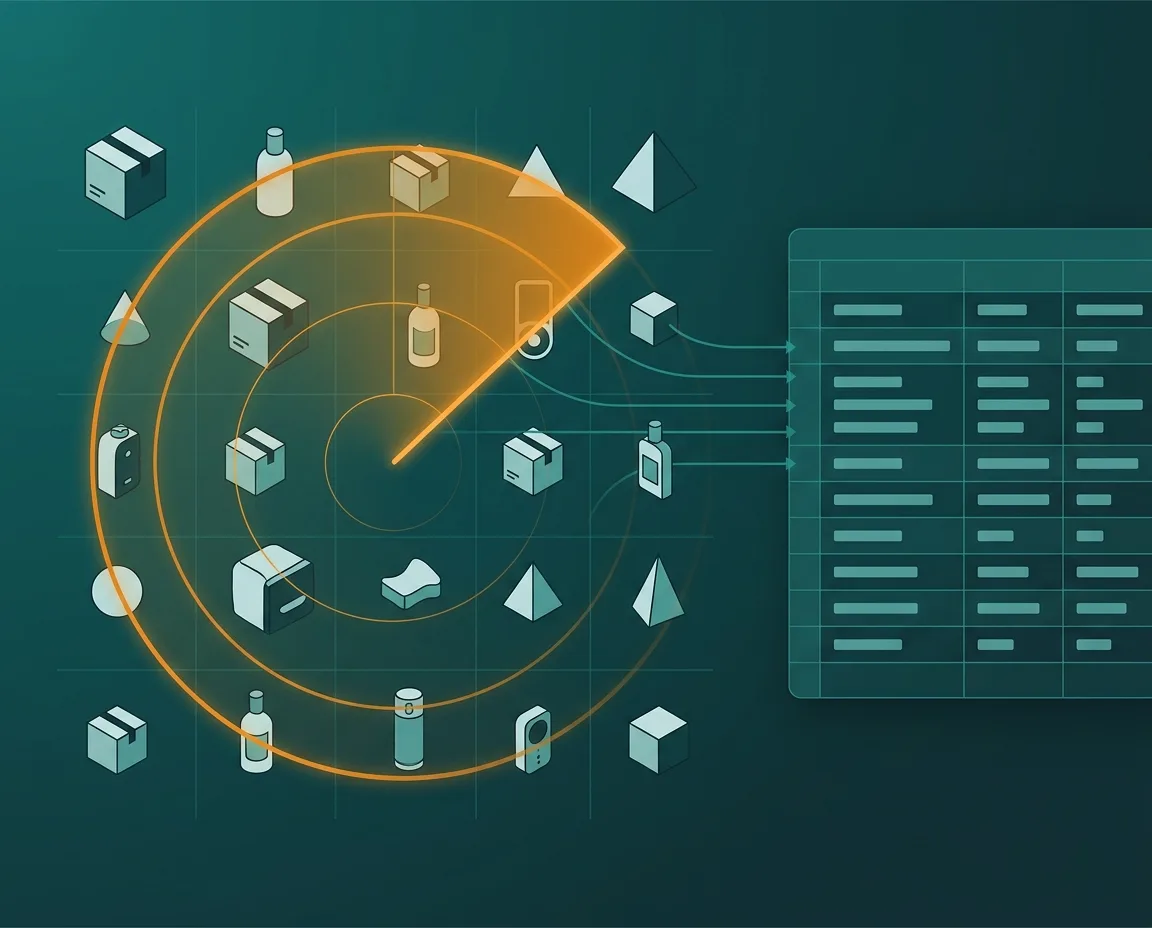
Brainova’s AI Product Research engine ingests a list of SKUs, barcodes, or product names and returns a complete, structured research file — descriptions, images, full specifications, variants, and pricing signals — in roughly 30 seconds per product. It’s the data layer that powers the rest of Brainova AI Inventory, available as a standalone research output (JSON or CSV) when you don’t need full storefront publishing.
Manual Product Research Is Costing You Revenue
Every hour an analyst spends Googling SKUs, opening manufacturer PDFs, and copy-pasting specs is an hour your catalogue isn’t growing. The numbers across e-commerce are unforgiving — and they all point to the same bottleneck.
87%
Shoppers research online before buying
Salsify, 2024
15–30 min
Per product for manual research
Industry benchmark
25%
Of retail ops time on catalogue data
Industry benchmark
30%
Of returns from incomplete info
Shopify Plus, 2024
The ROI math is brutal. At 20 minutes per SKU and CAD $25/hour for a research analyst, a 5,000-product catalogue is roughly CAD $42,000 in pure labour — before a single listing goes live, before a single sale is made, and before the first competitor gets there ahead of you. Compress that 20-minute cycle to 30 seconds and the same catalogue costs you a single overnight batch.
How is this different from Catalog Enrichment?
Product Research is the data engine. Use it when you need raw research output — a clean JSON or CSV file of descriptions, images, specs, and variants — to feed your own PIM, ERP, marketplace tool, or internal workflow. No publishing, no storefront integration, just the data.
Catalog Enrichment is the full pipeline: it uses this same research engine, adds quality gates and SEO copy generation, and publishes finished listings directly to your storefront. If you want shelf-ready listings on Shopify, choose Enrichment. If you want the underlying research to use however you like, choose Product Research.
How AI Product Research Works
How It Works
Feed the SKU list
Drop a CSV, paste barcodes, or push SKUs through the API. Batch sizes from 10 to 10,000+ — the engine fans out in parallel.
AI researches across 4 sources
For every SKU, the engine queries the brand manufacturer site (highest priority), the Shopify product graph, competitor and marketplace listings, and AI-grounded web search. Results are cross-referenced, deduplicated, and confidence-scored.
Structured output delivered
You receive a clean, normalized record per product — descriptions, hero + gallery images, full spec sheet, variants, brand identifiers, and pricing signals — exportable as JSON or CSV. Ready for your PIM, ERP, or downstream automation.
Feed the SKU list
Drop a CSV, paste barcodes, or push SKUs through the API. Batch sizes from 10 to 10,000+ — the engine fans out in parallel.
AI researches across 4 sources
For every SKU, the engine queries the brand manufacturer site (highest priority), the Shopify product graph, competitor and marketplace listings, and AI-grounded web search. Results are cross-referenced, deduplicated, and confidence-scored.
Structured output delivered
You receive a clean, normalized record per product — descriptions, hero + gallery images, full spec sheet, variants, brand identifiers, and pricing signals — exportable as JSON or CSV. Ready for your PIM, ERP, or downstream automation.
What the AI Finds
Product descriptions — your tone, your length
The engine pulls manufacturer copy, feature bullets, and use-case content from authoritative sources, then synthesizes a description in the tone you specify: marketing-led for D2C storefronts, technical-led for B2B and industrial catalogues, or short-form for marketplaces. Length and structure are configurable per batch.
Hero + gallery images
High-resolution product photography from brand sites and authorized retailers, scored for quality and angle coverage. Watermarked, low-res, and irrelevant images are filtered out automatically.
Full spec sheets
Dimensions, weight, materials, capacity, power, compatibility, certifications — every structured attribute the brand publishes, normalized into a consistent schema across your catalogue.
Variant detection + grouping
The engine recognizes when 12 SKUs are sizes of the same shoe or colour-ways of the same chair, and groups them under a parent product with proper variant axes — instead of dumping 12 isolated listings.
Brand / UPC / MPN verification
Cross-references the brand name, UPC/EAN barcode, and manufacturer part number against multiple sources to catch supplier typos and mismatched data before they pollute your catalogue.
Pricing signals
MSRP, market price range, and competitor min/max — useful for setting your own price, spotting MAP violations, and identifying where you have margin headroom.
Business Impact
Before / After
Before: analyst + 30 browser tabs
- One analyst, 15–30 minutes per SKU
- Manual Google searches across brand, retailer, and forum sites
- Copy-paste into a spreadsheet, inconsistent fields and formatting
- Images downloaded one at a time, often missing or low-res
- Dimensions guessed from product photos or skipped entirely
- 5,000 products = roughly 6 weeks of full-time work
After: AI research engine
- 30 seconds per SKU, parallelized across the batch
- 4-source data fusion — brand site prioritized, others cross-referenced
- Normalized, structured output in JSON or CSV — every SKU has the same fields
- Hero and gallery images, quality-scored and ready to import
- Spec sheets and dimensions populated with confidence scores
- 5,000 products = one overnight batch
How It Compares
| Capability | AI Product Research | Manual analyst | Data-entry VAs | Generic scraping tool |
|---|---|---|---|---|
| Time per SKU | ~30 seconds | 15–30 minutes | 8–15 minutes | 1–3 minutes |
| Multi-source aggregation | 4 sources, cross-referenced | 1–3 sources, manual | 1–2 sources, manual | Single site only |
| Structured output | Normalized JSON / CSV | Inconsistent spreadsheet | Inconsistent spreadsheet | Raw HTML / unstructured |
| Brand-site priority | Yes, weighted | Depends on analyst | No | No |
| Cost per SKU | Cents | CAD $5–$12 | CAD $1–$3 | Cents (but unusable output) |
Who Uses Product Research
E-commerce retailers
Online stores adding new product lines, cleaning legacy catalogues, or expanding into new categories without scaling the merchandising team.
Wholesale & distribution
Distributors with 10,000–100,000+ SKUs across many brands. Replaces fragmented manufacturer datasheets with a single, consistent research file.
Multi-channel sellers
Sellers listing on Shopify, Amazon, eBay, and marketplaces. Research once, reuse the same structured record across every channel.
Private-label brands
Brands sourcing from overseas manufacturers with sparse product data. The engine builds a complete listing record from a barcode and a factory photo.
Drop-shippers
Sellers receiving thin supplier feeds who need to differentiate listings with richer copy, better images, and complete specs.
Run the engine on your SKUs — live
Send us 5 SKUs ahead of time. We’ll research them in front of you on the demo call and hand back a clean JSON or CSV before we hang up.
Custom pricing scaled to catalogue size · Long-term contract with 30-day grace period · No free trials, only free demos.
Related solutions
- Catalog Enrichment — full pipeline including SEO copy, quality gates, and direct-to-storefront publishing
- Supplier-to-Store Automation — turn raw supplier feeds into live listings end-to-end
- Competitor Intelligence — continuous monitoring of competitor pricing and assortment
- Brainova AI Inventory — the full inventory automation platform
Frequently Asked Questions
About the Service
Anything that uniquely identifies a product: SKU, UPC/EAN barcode, manufacturer part number (MPN), brand + model name, or a product URL. You can mix identifier types in the same batch — the engine resolves them automatically. CSV upload, paste-in, or API ingestion are all supported.
Brand manufacturer websites (highest priority for descriptions, specs, and official imagery), the Shopify product graph (for listings already in the Shopify ecosystem), competitor and marketplace listings (for cross-validation and pricing signals), and AI-grounded web search (for niche specs, reviews, and supplementary data not found in the first three).
Structured JSON by default — one record per product with a consistent schema covering descriptions, image URLs, spec key-value pairs, variants, identifiers, and pricing signals. CSV export is also available, as well as direct API delivery into your downstream system.
Product Research is the data engine — it returns raw, structured research output (JSON/CSV) that you use however you like. Catalog Enrichment uses the same engine but adds quality gates, SEO copy generation, dimension estimation refinement, and direct publishing to Shopify. Choose Product Research for data, Catalog Enrichment for finished listings.
Getting Started
The engine cross-references multiple sources for every field, with brand-site data weighted highest. Each field returns a confidence score so you can route low-confidence items to manual review. For most consumer and commercial products, the engine produces high-confidence, complete records on the first pass.
Some SKUs — especially niche industrial parts, brand-new releases, or generic/unbranded items — have limited data online. The engine flags these explicitly with a low-confidence indicator and returns whatever partial data it found, so you know exactly which items need human attention.
The engine is region-aware. For Canadian retailers we prioritize Canadian brand sites, .ca retailer listings, and CAD pricing signals. For US-focused catalogues we prioritize US sources and USD pricing. Mixed catalogues are handled per-SKU based on the brand's primary market.
Pricing scales with monthly research volume and is quoted per engagement — there are no published per-SKU rates because batch size, source depth, and integration complexity all change the equation. Book a demo and we'll quote against your actual catalogue size and cadence. No free trials, demos only.