
Incomplete Product Data Costs You Sales
Bare SKUs don’t sell. Shoppers compare titles, scan specs, and zoom into images before they buy — and when any of that is missing, they bounce. The compounding cost shows up in conversion rate, return rate, and search visibility every single week.
87%
Rely on product content
Of online shoppers say product content is extremely or very important to their purchase decision.
Salsify Consumer Research, 2024
30%
Higher conversion
Lift on enriched PDPs versus skeleton listings — descriptions, images, specs, and variants in place.
Salsify, 2024
40%
Fewer returns
Reduction in return rate when shoppers see accurate dimensions, materials, and variant specs up front.
Shopify Plus benchmark
94%
First impressions
Of first impressions are design and content driven — a half-built product page tells shoppers exactly what to expect.
Stanford Web Credibility
The math is brutal. If 5,000 SKUs sit unlisted because manual enrichment takes 15–30 minutes each, that’s 1,250–2,500 hours of work — and every week of delay is a week competitors with complete listings capture the search traffic and the conversions. AI catalog enrichment closes that gap in hours, not quarters, and pays for itself the moment those SKUs go live.
From Bare SKU to Conversion-Ready PDP
Same product, two different listings. The left is what your supplier sends you. The right is what shoppers actually buy from.
SKU-4471-BLK
- ×Title only — no marketing copy
- ×Single placeholder thumbnail
- ×Missing specs, dimensions, materials
- ×No SEO description, no meta tags
- ×Variants flattened into separate orphan SKUs
- ×Wholesale price only — no retail framing
Full conversion-ready listing
- ✓Brand-voiced title and 200-word SEO description
- ✓Hero image plus full lifestyle gallery
- ✓Complete spec sheet — dimensions, weight, materials, compatibility
- ✓Meta title, meta description, structured data ready
- ✓Variants grouped under one parent — size, colour, configuration
- ✓Pushed direct to Shopify, BigCommerce, or Woo
How Catalog Enrichment Works
Three stages, fully managed. You hand us a supplier file or a Shopify connection — we hand you back a publish-ready catalog.
How It Works
Ingest Your Supplier Catalog
Upload CSV, paste a supplier sheet, connect Shopify directly, or drop a manufacturer feed. The platform identifies which fields are missing for every SKU — descriptions, images, specs, dimensions, variants — and queues them for enrichment in priority order.
AI Researches 4 Sources and Writes Copy
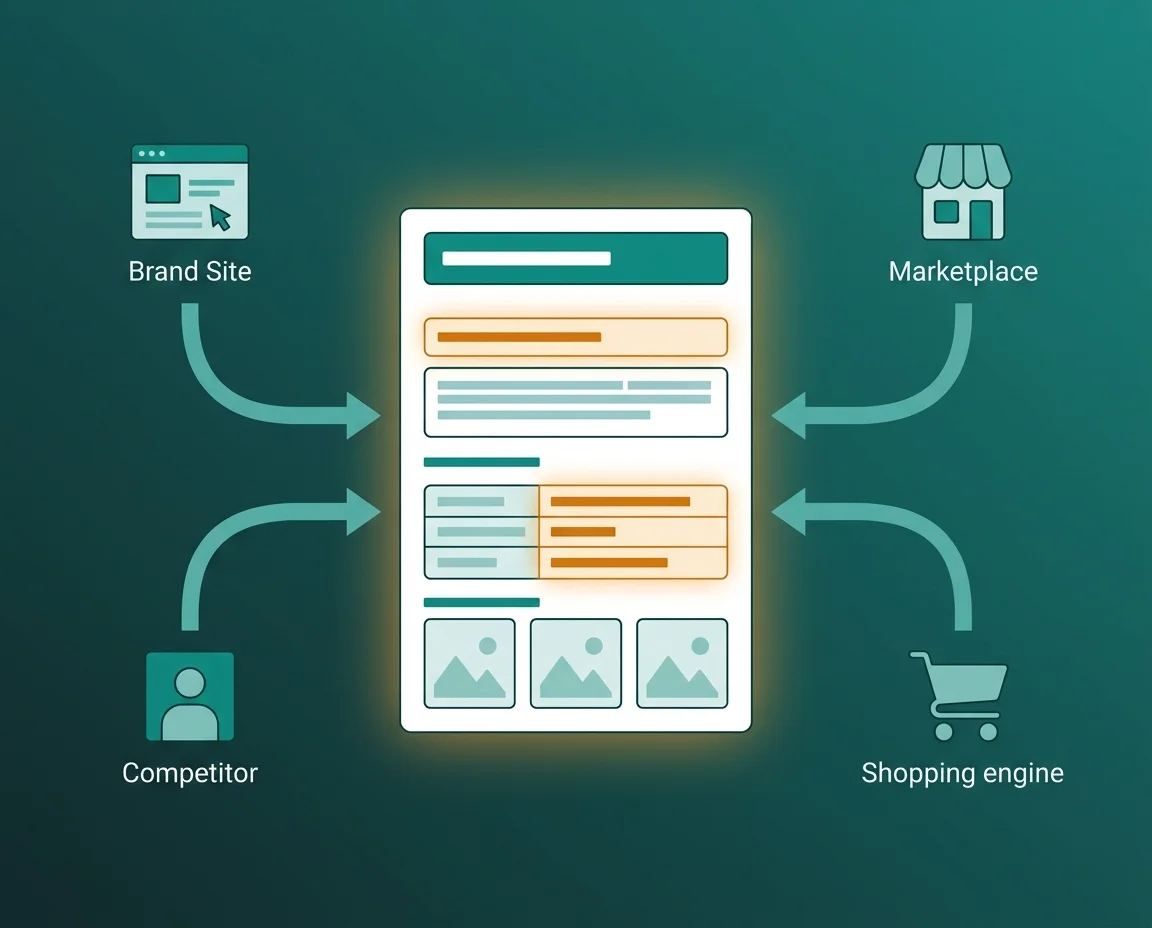
For each product, the system searches the brand manufacturer site, Amazon, direct competitor stores, and Google Shopping. It cross-references data, discovers and scores images, estimates dimensions, detects variant relationships, and writes SEO-optimized copy in your brand voice — never generic AI filler.
Human QA, Then Push to Your Store
Every enriched product passes through configurable quality gates and a human review queue. Approve, edit, or flag in bulk. When you're satisfied, publish straight to Shopify, BigCommerce, or WooCommerce — individually or 1,000 SKUs at a time.
Ingest Your Supplier Catalog
Upload CSV, paste a supplier sheet, connect Shopify directly, or drop a manufacturer feed. The platform identifies which fields are missing for every SKU — descriptions, images, specs, dimensions, variants — and queues them for enrichment in priority order.
AI Researches 4 Sources and Writes Copy
For each product, the system searches the brand manufacturer site, Amazon, direct competitor stores, and Google Shopping. It cross-references data, discovers and scores images, estimates dimensions, detects variant relationships, and writes SEO-optimized copy in your brand voice — never generic AI filler.
Human QA, Then Push to Your Store
Every enriched product passes through configurable quality gates and a human review queue. Approve, edit, or flag in bulk. When you're satisfied, publish straight to Shopify, BigCommerce, or WooCommerce — individually or 1,000 SKUs at a time.
What Gets Enriched
A complete PDP — not a stitched-together summary. Every field that influences ranking, conversion, or returns gets filled in.
Multi-Source Product Research
No single source has the full story. The platform fuses data from four authoritative places so the resulting profile is complete and accurate — not whatever one feed happened to ship.
- •Brand site: official descriptions, hero images, full spec sheets.
- •Amazon: bullet-point conventions, lifestyle imagery, review-validated specs.
- •Competitor stores: pricing, positioning, variant naming patterns.
- •Google Shopping: long-tail attributes and supplementary specs.
SEO-Optimized Descriptions
Generated from researched product data, not invented. Unique, keyword-rich copy in your brand voice — built for the queries shoppers actually type.
Image Discovery + Gallery
Finds product photos across brand and authoritative sources, scores for quality and relevance, and assembles a hero image plus gallery — no FTP digging.
Quality Gates + Brand Voice Review
No catalog enrichment goes live unsupervised. Configurable thresholds plus a human reviewer keep your store’s credibility intact.
- •Set required-field thresholds — minimum description length, image count, spec depth.
- •Brand voice profile applied per store — tone, vocabulary, banned phrases.
- •Low-confidence enrichments flagged for review, never auto-published.
- •Bulk approve, edit, or reject — single-product or 1,000-SKU batches.
Full Spec Sheets
Dimensions, weight, materials, compatibility, model numbers, warranty terms — extracted from sources, normalized, and structured for filtering.
Variant Detection + Grouping
Detects size, colour, and configuration variants across loose supplier SKUs and groups them under one parent product with proper option axes.
Dimension Estimation and Variant Detection
Two enrichment differentiators that solve the most painful manual tasks in any inventory backlog — and the two areas where competitors using generic PIMs or freelancers fall down hardest.
Dimension Estimation from Images
Accurate shipping dimensions are non-negotiable for e-commerce. Wrong dimensions trigger carrier surcharges, blow up shipping calculators at checkout, and erode margin SKU by SKU. The platform estimates length, width, height, and weight from product images and reference cues — giving you usable shipping data immediately, before anyone physically measures a thing. Refine as products are picked and packed; live with approximations until then.
Smart Variant Detection
Supplier feeds love to flatten variants into orphan SKUs — fifteen separate listings for the same shoe in fifteen sizes. The platform reads titles, descriptions, and spec patterns across sources to detect those relationships, then groups variants under a single parent product with clean option axes (size, colour, material, configuration). One PDP, proper inventory, no duplicate-content SEO penalty.
Business Impact
Enriched listings move every metric that matters at once: organic search visibility, click-through, conversion rate, average order value, and return rate. The compounding effect is what makes this the highest-ROI catalog work most retailers can do — and the work that almost never gets prioritized because it’s so painful to do manually.
How It Compares
| Feature | AI Catalog Enrichment | In-house copywriter | Generic PIM + freelancers |
|---|---|---|---|
| Time per SKU | 1–3 minutes | 15–30 minutes | 20–45 minutes (handoffs) |
| Multi-source research | Yes — 4 sources fused | Manual, single source | Manual, varies by freelancer |
| SEO optimization | Built-in, brand-voiced | Depends on writer skill | Inconsistent across freelancers |
| Image discovery | Automatic, scored | Manual hunting | Manual hunting |
| Quality control | Configurable gates + human QA | Editor review | Project manager review |
| Cost per SKU | Scales with volume | $5–$15 fully loaded | $8–$25 plus PIM licence |
In-house copywriters produce the best individual listings — when you can afford them and they have time. Generic PIMs organize data you already have but don’t create what’s missing. AI catalog enrichment fills the gap nobody else does: turning skeleton SKUs into complete listings at catalog scale, with humans only on QA.
Who It’s For
Catalog enrichment solves the same core problem — unlisted or poorly listed products — across several retail business types.
E-commerce Retailers
Thousands of supplier SKUs sitting unlisted because writing PDPs takes too long.
Learn more →Brick-and-Mortar Going Online
Physical inventory with zero digital content — get the whole catalog online in weeks, not years.
Learn more →Wholesale & Distributors
10,000–100,000+ SKU catalogs that need to be searchable and orderable by B2B buyers online.
Learn more →Multi-Brand Retailers
Catalogs spanning dozens of vendors with inconsistent feeds — normalize and enrich them all in one pass.
Learn more →Drop-Shippers
Minimal supplier data plus the same catalog as everyone else — differentiate with unique, enriched listings.
Learn more →Enrich your catalog in hours, not weeks
Book a demo and we’ll enrich a sample of your real SKUs live on the call. See the descriptions, images, specs, and variants land in a publish-ready preview before you commit to anything.
Custom pricing scaled to catalog size · Long-term contract with 30-day grace period · No free trials, only free demos.
Related solutions
- AI Product Research Pipeline
- Supplier-to-Store Automation
- Competitor Intelligence
- Brainova AI Inventory hub
Frequently Asked Questions
About the Service
Catalog enrichment is the process of filling in missing product data — descriptions, images, specifications, dimensions, variants — to turn skeleton SKUs into complete, conversion-ready PDPs. Brainova AI Inventory automates this by researching every product across the brand site, Amazon, competitor stores, and Google Shopping, then writing SEO-optimized copy in your brand voice and pushing it straight to your store.
The brand manufacturer site (official descriptions, hero images, full specs), Amazon (bullet conventions, lifestyle imagery, review-validated specs), direct competitor stores (pricing, positioning, variant naming), and Google Shopping (long-tail attributes and supplementary specs). Data from all four is cross-referenced to build the most complete, accurate product profile possible.
Descriptions are written from verified, researched product information — never invented. Cross-referencing across four sources catches contradictions and low-confidence fields are flagged automatically. Every enriched product passes through configurable quality gates and a human review queue. Nothing publishes without your approval.
Yes. We configure a brand voice profile per store — tone, vocabulary, banned phrases, sentence structure preferences. The AI writes within that profile, and a human reviewer signs off on bulk batches before they push live. The result reads like your in-house copywriter wrote it, not like generic AI filler.
Getting Started
Direct push to Shopify, BigCommerce, and WooCommerce. For Magento, custom platforms, or PIM-first workflows, the platform exports complete CSV files with every field structured correctly for import. Additional native integrations are on the roadmap.
Most SKUs complete in 1–3 minutes depending on data availability. A batch of 1,000 products typically finishes within a few hours. Compared to 15–30 minutes per SKU for manual enrichment, that's a 10–15× speed improvement at minimum — and the entire pipeline runs in parallel.
Custom pricing scaled to catalog size and SKU velocity — there are no per-SKU surprise fees and no free trials, only free demos. Engagements run on long-term contracts with a 30-day grace period. Book a demo and we'll scope pricing against your actual catalog and a sample enrichment run on the call.
Setup is fully managed. Hand us a supplier feed or a Shopify connection on the demo call, and we'll show you enriched sample SKUs the same day. Full catalogs typically go live within days to weeks depending on size and review cadence — not the months a freelancer team would take.