AI ROI Calculator for Small Business: Measure Your Return

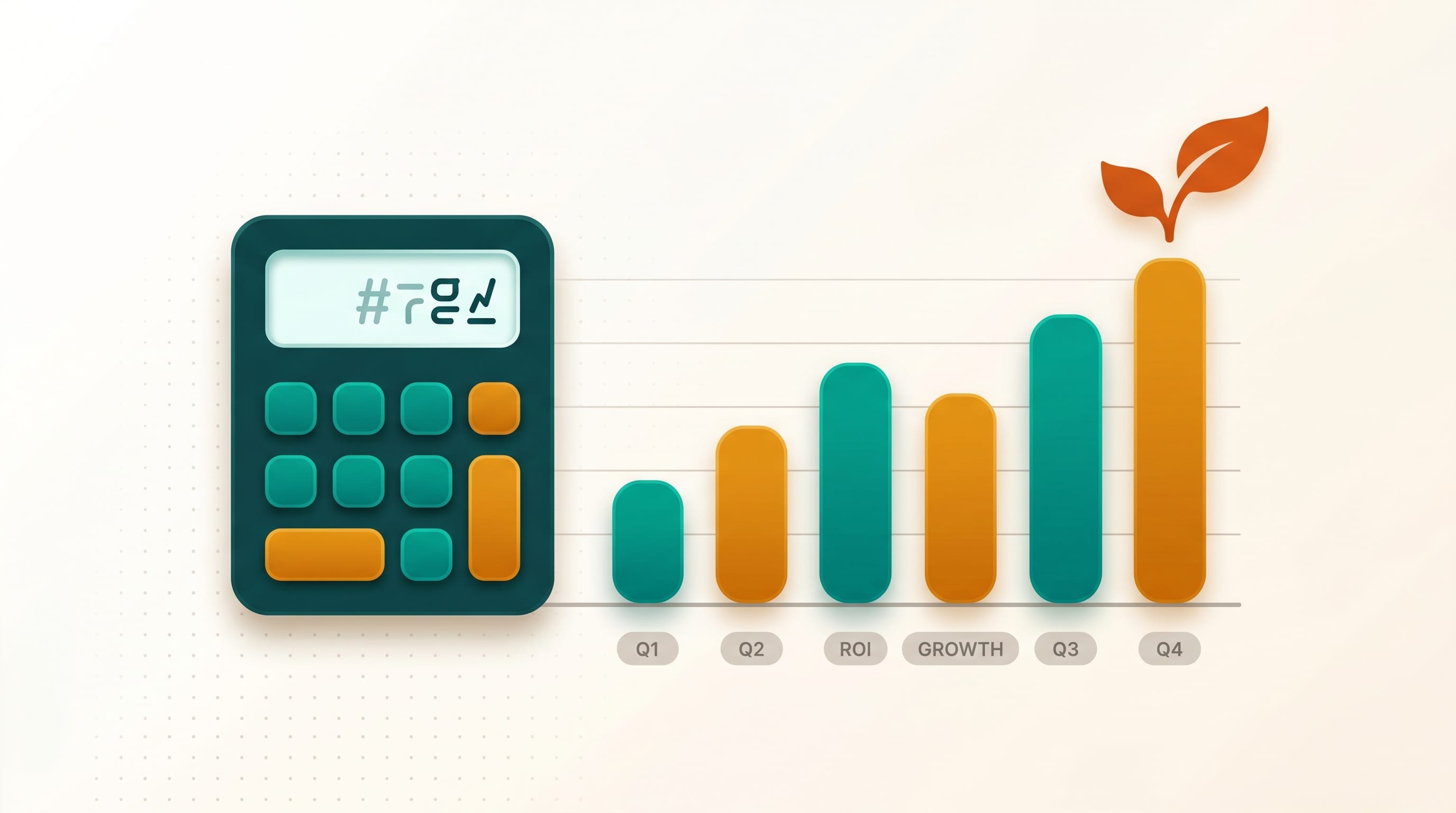
Calculate AI ROI with this formula: (Value of time saved + Revenue from recovered opportunities + Cost reduction) / Total AI investment x 100. Most small businesses see 150-300% ROI in the first year from AI phone answering and workflow automation alone. A mid-size business spending $500/month on AI tools and recovering $2,000/month in previously lost revenue and productivity is earning a 300% annual return on that investment.
Key Takeaways
- AI ROI formula: (Time savings + Revenue recovery + Cost reduction) / Total investment x 100
- Average first-year ROI by use case: AI phone answering (200-400%), workflow automation (150-300%), customer support (100-250%)
- Most businesses break even within 30-60 days on AI phone answering and 60-90 days on workflow automation
- Measure ROI accurately by establishing baselines before implementation — not after
- Honest assessment: AI does not pay off for every use case — low volume and wrong-fit problems are the most common exceptions
The AI ROI Formula
Calculating AI return on investment does not require a finance degree. The formula has three value components and one cost component:
AI ROI = ((A + B + C) - D) / D x 100
Where:
- A = Value of time saved — Hours saved per month x hourly cost of the employee doing the work
- B = Revenue from recovered opportunities — Missed calls, leads, or sales recovered x average customer value
- C = Cost reduction — Direct cost savings from reduced errors, eliminated software, or reduced headcount needs
- D = Total AI investment — Monthly subscription + implementation cost (amortized monthly) + ongoing optimization
The result is your ROI percentage. Anything above 100% means you are earning more than you spend. Anything above 200% means you are earning double your investment.
Step 1: Calculate Time Savings (Variable A)
Time savings is usually the largest ROI component for workflow automation.
Formula: Hours saved per week x 4.33 (weeks/month) x Fully loaded hourly rate = Monthly time savings value
How to estimate hours saved:
Identify the specific tasks AI will handle. Time each task today — how long does it take a human? Then estimate the AI processing time (usually 90-95% faster for data processing tasks).
Benchmark data by use case:
| AI Use Case | Typical Hours Saved/Employee/Week | Source |
|---|---|---|
| Workflow automation (data entry, email routing) | 8-20 hours | Asana Anatomy of Work, 2025 |
| Document processing and review | 5-15 hours | IBM, 2025 |
| Customer support (Tier 1 deflection) | 10-25 hours | Zendesk CX Trends, 2025 |
| Report generation | 3-8 hours | Deloitte, 2025 |
Worked example:
An office manager spends 12 hours/week on invoice processing, email sorting, and data entry. Their fully loaded cost (salary + benefits + taxes) is $28/hour.
- Time saved: 12 hours/week x 4.33 = 52 hours/month
- Value: 52 hours x $28/hour = $1,456/month in time savings
Step 2: Calculate Revenue Recovery (Variable B)
Revenue recovery is the biggest ROI driver for AI phone answering and sales automation.
Formula: Missed opportunities recovered per month x Average customer lifetime value = Monthly revenue recovery
How to estimate revenue recovery:
For AI phone answering, start with your current missed call data. Most phone systems or providers can show you how many calls go unanswered. Then apply the conversion rate — what percentage of answered calls result in a new customer or booking?
Industry benchmarks for customer value:
| Industry | Average New Customer Value | Average Missed Calls/Month (SMB) |
|---|---|---|
| Law firms | $3,000-$5,000 per client | 40-80 (Clio, 2025) |
| Veterinary clinics | $300-$800 per client | 30-60 (AVMA, 2024) |
| Home services | $200-$800 per job | 50-100 (ServiceTitan, 2025) |
| E-commerce/retail | $50-$300 per order | 20-50 (Shopify, 2025) |
| Real estate | $5,000-$15,000 per transaction | 30-70 (NAR, 2025) |
Worked example:
A veterinary clinic misses approximately 45 calls per month. Of those, an estimated 30% are new client inquiries (13.5 potential clients). With AI phone answering, they recover 80% of those (10.8 clients). Average new client value: $500.
- Recovered clients: 10.8/month
- Revenue recovery: 10.8 x $500 = $5,400/month in recovered revenue
Even if the actual recovery rate is half that estimate, it is still $2,700/month — well above the cost of any AI phone solution.
Step 3: Calculate Cost Reduction (Variable C)
Cost reduction captures direct savings beyond time — things you spend less money on.
Common cost reductions from AI:
- Reduced overtime: AI handles after-hours work that previously required overtime pay
- Eliminated software: AI replaces multiple single-purpose tools (separate answering service, data entry service, support ticket routing)
- Fewer errors: Manual data entry errors cost $100-$1,000+ each to find and fix. AI reduces errors by 90-95%
- Reduced hiring needs: AI handles tasks that would otherwise require hiring an additional employee
Formula: Sum of all direct cost reductions per month = Monthly cost reduction
Worked example:
A 20-person business currently pays $2,500/month for a live answering service, $500/month for a data entry contractor, and estimates $800/month in costs from manual data errors (rework, customer credits, correction time).
- Answering service replaced by AI: $2,500/month saved
- Data entry contractor replaced: $500/month saved
- Error reduction (90%): $720/month saved
- Total cost reduction: $3,720/month
Step 4: Total Your Investment (Variable D)
Be honest and thorough about total costs. Include everything.
AI investment components:
| Cost Component | Typical Range | Frequency |
|---|---|---|
| Monthly SaaS subscription | $99-999/month | Monthly |
| Implementation/setup | $0-50,000 | One-time (amortize over 12 months) |
| Integration development | $2,000-15,000 | One-time (amortize over 12 months) |
| Ongoing optimization | $500-2,000/month | Monthly (first 6 months) |
| Team training | $500-2,000 | One-time (amortize over 12 months) |
Worked example:
A business deploys AI phone answering ($299/month) and workflow automation ($499/month) with professional implementation ($12,000 one-time, amortized = $1,000/month for year 1).
- Monthly subscriptions: $299 + $499 = $798
- Amortized implementation: $1,000
- Ongoing optimization (first 6 months): $1,000
- Total monthly investment: $2,798 (months 1-6), $1,798 (months 7-12)
Step 5: Calculate Your ROI
Now combine all four variables.
Full worked example — mid-size veterinary clinic:
| Component | Monthly Value |
|---|---|
| A: Time savings (office staff) | $1,456 |
| B: Revenue from recovered calls | $5,400 |
| C: Cost reduction (answering service, errors) | $3,720 |
| Total monthly value (A+B+C) | $10,576 |
| D: Total monthly investment | $2,798 |
| Monthly net gain | $7,778 |
| ROI | 278% |
Over 12 months, this clinic would invest approximately $27,576 in AI tools and implementation, and gain $126,912 in time savings, recovered revenue, and cost reduction — a net gain of $99,336. That is a 360% annualized ROI (improving as amortized implementation costs drop off in year 2).
ROI Benchmarks by AI Use Case
Based on aggregated data from Deloitte, McKinsey, and industry reports, here are typical first-year ROI ranges:
| AI Use Case | Typical Year 1 ROI | Primary Value Driver | Breakeven Timeline |
|---|---|---|---|
| AI phone answering | 200-400% | Revenue recovery from missed calls | 2-4 weeks |
| Workflow automation | 150-300% | Time savings on repetitive tasks | 30-90 days |
| Customer support automation | 100-250% | Reduced support labor + faster response | 60-90 days |
| Data enrichment / catalog management | 100-200% | Improved conversion rates + reduced returns | 90-180 days |
| Marketing automation | 75-200% | Increased content output + lead generation | 90-180 days |
Sources: McKinsey Global Institute, 2025; Deloitte AI Survey, 2025
When AI Does NOT Pay Off
Honest assessment: AI is not universally profitable. Here are the situations where ROI is negative or negligible:
Too-Low Volume
If you receive 15 calls per month and handle all of them yourself, a $299/month AI phone agent does not generate meaningful returns. The math only works when volume is high enough that missed opportunities or time costs exceed the AI subscription.
Threshold guidance: AI phone answering typically requires 50+ calls/month to justify cost. Workflow automation requires 10+ hours/week of manual work per automated process.
Wrong Use Case
AI excels at repetitive, data-heavy, pattern-based tasks. It struggles with deeply creative work, high-stakes emotional interactions, and one-off problems that do not repeat. Automating a task that happens twice a month is not worth the implementation cost.
Poor Implementation
A well-chosen AI tool that is poorly implemented — wrong configuration, incomplete integration, no team training — will underperform. ROI is a function of both the tool and the implementation quality. This is why choosing the right AI integration partner matters.
Unrealistic Measurement
If you do not establish baselines before implementing AI, you cannot measure ROI accurately. “It feels faster” is not a business case. Track specific metrics: calls answered, hours saved, errors reduced, revenue recovered.
ROI Worksheet
Use this template to calculate your own AI ROI. Fill in your actual numbers.
Section A — Time Savings:
- Task 1: ___ hours/week x $/hour x 4.33 = $/month
- Task 2: ___ hours/week x $/hour x 4.33 = $/month
- Task 3: ___ hours/week x $/hour x 4.33 = $/month
- Total time savings: $___/month
Section B — Revenue Recovery:
- Missed opportunities/month: ___
- Recovery rate with AI (estimate 60-80%): ___
- Average customer value: $___
- Total revenue recovery: $___/month
Section C — Cost Reduction:
- Services/tools replaced: $___/month
- Error cost reduction (estimate 90%): $___/month
- Overtime/hiring avoided: $___/month
- Total cost reduction: $___/month
Section D — Investment:
- AI subscriptions: $___/month
- Implementation (divide by 12): $___/month
- Ongoing optimization: $___/month
- Total investment: $___/month
ROI Calculation:
- Total monthly value (A+B+C): $___
- Total monthly investment (D): $___
- Monthly net gain: $___
- ROI: (Value - Investment) / Investment x 100 = ___%
Related reading:
- AI for Small Business: Where to Start
- AI Integration Project Timeline & Cost
- Brainova Talk — AI Voice Agents
- Custom AI Integration
- Workflow Automation Services
Last Updated: March 16, 2026
Frequently Asked Questions
About the Service
Most small businesses see measurable ROI within 30-90 days. AI phone answering delivers the fastest returns — often within 2-4 weeks, since recovering a few missed calls covers the monthly cost. Workflow automation typically shows clear ROI within 60-90 days as time savings accumulate. More complex implementations (data enrichment, custom AI workflows) may take 90-180 days to reach full ROI.
Typical first-year ROI ranges from 100% to 400% depending on the use case. AI phone answering averages 200-400% (driven by recovered revenue from missed calls). Workflow automation averages 150-300% (driven by time savings). Customer support automation averages 100-250%. These benchmarks come from aggregated data across Deloitte, McKinsey, and industry reports.
Establish baselines before implementing AI — measure your current missed calls, hours spent on manual tasks, error rates, and costs. After deployment, track the same metrics at 30, 60, and 90-day intervals. Use the three-variable formula: (time savings + revenue recovery + cost reduction) divided by total investment times 100. The key is measuring specific metrics, not relying on subjective impressions.
Getting Started
Negative ROI usually indicates one of three problems: wrong use case (the task is too low-volume to justify automation), poor implementation (the AI is not properly configured or integrated), or wrong tool (the product does not fit your needs). Before abandoning AI entirely, diagnose which factor is the cause. Often, reconfiguring the tool or switching to a better-fit product resolves the issue.
Track intangible benefits (employee satisfaction, faster response times, better customer experience) separately — but do not include them in your ROI calculation. Your ROI number should be defensible with hard data. Once you have proven financial ROI, intangible benefits strengthen the business case for expanding AI investment. Leading with intangibles alone makes it too easy to justify tools that are not actually paying off.